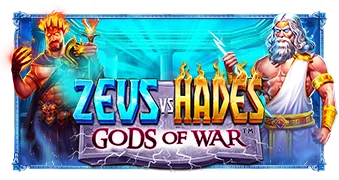
Zeus vs Hades: Gods of War uses a clear visual opposition: the bright heights of Olympus and the darker underworld. That contrast is more than a change of scenery. The developer describes different feature profiles for the two modes, making this an interesting case study in how a game presents a choice without making the underlying randomness visible.
- Developer
- Pragmatic Play
- Mode pairing
- Olympus and Hades
- Feature element
- Expanding wilds
- Review focus
- Mode presentation and interpretation
Specification basis: Pragmatic Play product documentation.
What changes when the setting changes
The developer characterises Olympus as having more frequent features with lower average feature values, and Hades as having less frequent features with higher average values. The game also uses expanding wilds and a free-spins feature. These are descriptions of a distribution, not a schedule of events.
The difference between frequency and size is easy to lose in a short explanation. ‘More frequent’ does not mean regular, and ‘higher average’ does not mean every example is larger. A mode can have a stated aggregate profile while a short observed sequence looks entirely unlike a reader's expectation.
Two averages cannot describe every outcome
Imagine two fictional datasets with different average event sizes. Knowing their means alone does not reveal how often either set contains zero, how widely values vary or where the extreme values sit. This basic statistical point applies to any attempt to compare feature profiles.
That is why a small gallery of selected results cannot establish which mode behaves better for a particular person. A gallery may be useful for showing colours, labels and animations. It becomes weak evidence when asked to stand in for a complete probability distribution.
Expanding wilds as a visual event
Expansion is an especially visible transformation because an object changes the space it occupies. For an interface analysis, it is useful to separate the symbol's arrival from its expansion and from the final evaluation. Those stages may happen quickly, but they answer different questions.
The visual effect can make an event seem larger simply because more screen area changes. Screen area and mathematical contribution are not interchangeable measures. A precise caption or explanation should identify the rule responsible for the transformation rather than describe the animation as inherently more valuable.
Three useful distinctions
| Term | What it describes |
|---|---|
| Frequency | How often an event occurs over a defined population. |
| Average size | A summary of event values, not a minimum. |
| Visible state | The selected mode and currently displayed symbols. |
Olympus and the underworld as information design
The opposing environments create a strong mnemonic: readers can remember which mode they are looking at without relying only on a small text label. This can support orientation, especially when the game otherwise retains a similar overall layout.
Colour should still supplement rather than replace text. A clear mode name helps readers who cannot easily distinguish hues and helps anyone comparing monochrome captures. The same principle applies to an explanatory article: naming the mode next to an example prevents the scenery from becoming the only source of information.
What this comparison leaves unresolved
The official description supports the existence of distinct profiles. It does not provide enough detail for this article to calculate a personal outcome or a reliable waiting time between features. We have not manufactured a session history to fill that gap.
Our assessment is therefore limited to the design of the choice and the clarity of its explanation. The distinctive setting makes the two modes easy to identify. The harder editorial task is preventing everyday words such as ‘frequent’ and ‘average’ from being mistaken for promises about the next few events.
Questions about Zeus vs Hades: Gods of War
Does a more frequent feature arrive at fixed intervals?
No. Frequency is an aggregate description; it is not a countdown.
Can artwork identify a mode?
It can help, but the mode label is clearer evidence than colour alone.
Did this review compare real-money sessions?
No. It analyses the developer's mode descriptions and the way the two settings communicate them.
Source notes
The feature descriptions refer to Pragmatic Play’s documentation for Zeus vs Hades: Gods of War. The interface analysis is our editorial interpretation. Source material checked on 24 September 2026.
Game imagery: Pragmatic Play. Read about sources, illustrations and review scope.