Book of Dead is a useful starting point for understanding the difference between a payline and an expanding symbol. Its Egyptian setting is immediately recognisable, but the interesting design decision is structural: most of the screen remains familiar when the feature changes the way one symbol behaves. This review separates that rule change from the adventure artwork surrounding it.
- Reel layout
- 5 reels × 3 rows
- Win evaluation
- 10 selectable paylines
- Feature
- 10 free spins from 3 scatters
- Key distinction
- A selected expanding symbol
Specification basis: Play’n GO product documentation.
A small grid with a clear reading order
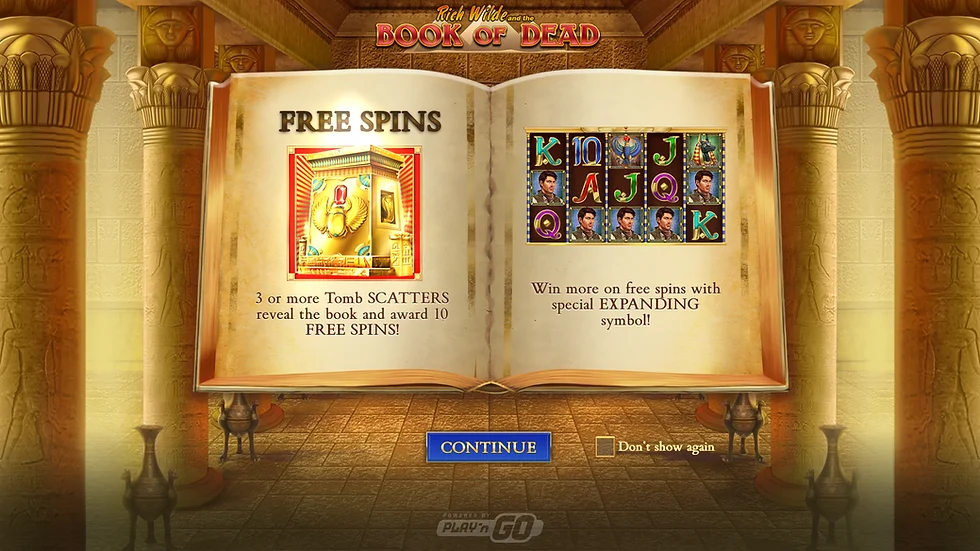
The developer describes five reels, three rows and ten selectable lines. The book combines wild and scatter roles, while the feature selects a symbol that can expand across reels when the relevant conditions are met. Three scatters start ten free spins. Those rules explain the design without needing to treat every Egyptian icon as a separate feature.
A fixed-line layout creates a particular reading habit: follow a path across the columns, then check the highlighted result. That differs from a cluster game, where neighbouring cells matter, and from an anywhere-pay game, where the count of matching symbols matters. Confusing these three systems can make a perfectly ordinary result look unexplained.
Why expansion changes the picture
An expanding symbol is a change to evaluation, not simply a larger drawing. The important question is which positions count after the feature resolves. A still image taken before expansion and one taken afterwards can therefore tell different parts of the same event.
For an illustrated explanation, the most useful pair of frames would preserve the original symbol positions and the final expansion. Cropping out the reels or showing only the total removes that context. Our reading of the design is that it creates suspense through a visible transformation; the animation itself does not establish how frequently that transformation occurs.
The book has two jobs
Wild and scatter are different concepts even when one icon represents both. A wild participates in symbol substitution under the game's rules. A scatter is evaluated through its own condition. A reader should not assume that an icon's behaviour is identical in every situation merely because its artwork stays the same.
This dual role makes Book of Dead visually economical. It also creates a teaching problem: a one-line description such as ‘the book is special’ leaves out the relevant distinction. In a clear review, the role should be named alongside the example, rather than asking the reader to infer it from the colour of an animation.
Three useful distinctions
| Term | What it describes |
|---|---|
| Payline | A defined path used to evaluate symbols. |
| Wild | A substitution role governed by the rules. |
| Expanding symbol | A feature-specific change to occupied positions. |
Adventure art and interface density
The published imagery uses an ornate frame, Egyptian motifs and a named explorer. Together these provide a strong setting without requiring a large number of separate locations. The characters and symbols remain the main visual identifiers; the surrounding scenery provides context.
For a small-screen assessment, the meaningful questions are whether the selected lines remain legible, whether the help text can be enlarged and whether the feature's chosen symbol is clearly identified. These are evaluation criteria, not a claim that every operator's wrapper or every mobile device has been tested. A branded loading screen alone cannot answer them.
What a recorded result can establish
A screenshot can document the interface and a particular displayed state. It cannot provide a reliable estimate of long-run return, feature frequency or the distribution of outcomes. Even a sequence of recorded rounds would need a defined sampling method before it could support a statistical claim.
This matters especially when a review highlights a dramatic expansion. The frame may accurately show what happened while still being unrepresentative of ordinary results. We describe the mechanism here rather than assign a score for earning potential. The useful comparison with other games is the clarity of its state change and the simplicity of its base layout.
Questions about Book of Dead
Is Book of Dead a cluster game?
No. The developer describes a payline system. Adjacent groups are not the organising principle used in this review.
Does the artwork reveal the active rules?
Only partly. The full title and the help screen identify the version; the Egyptian theme alone does not.
What is the focus of this review?
The structure of the reel system, the expanding-symbol feature and how clearly the interface communicates them.
Source notes
The feature descriptions refer to Play’n GO’s documentation for Book of Dead. The interface analysis is our editorial interpretation. Source material checked on 24 September 2026.
Game imagery: Play’n GO. Read about sources, illustrations and review scope.